
A Letter From the Author
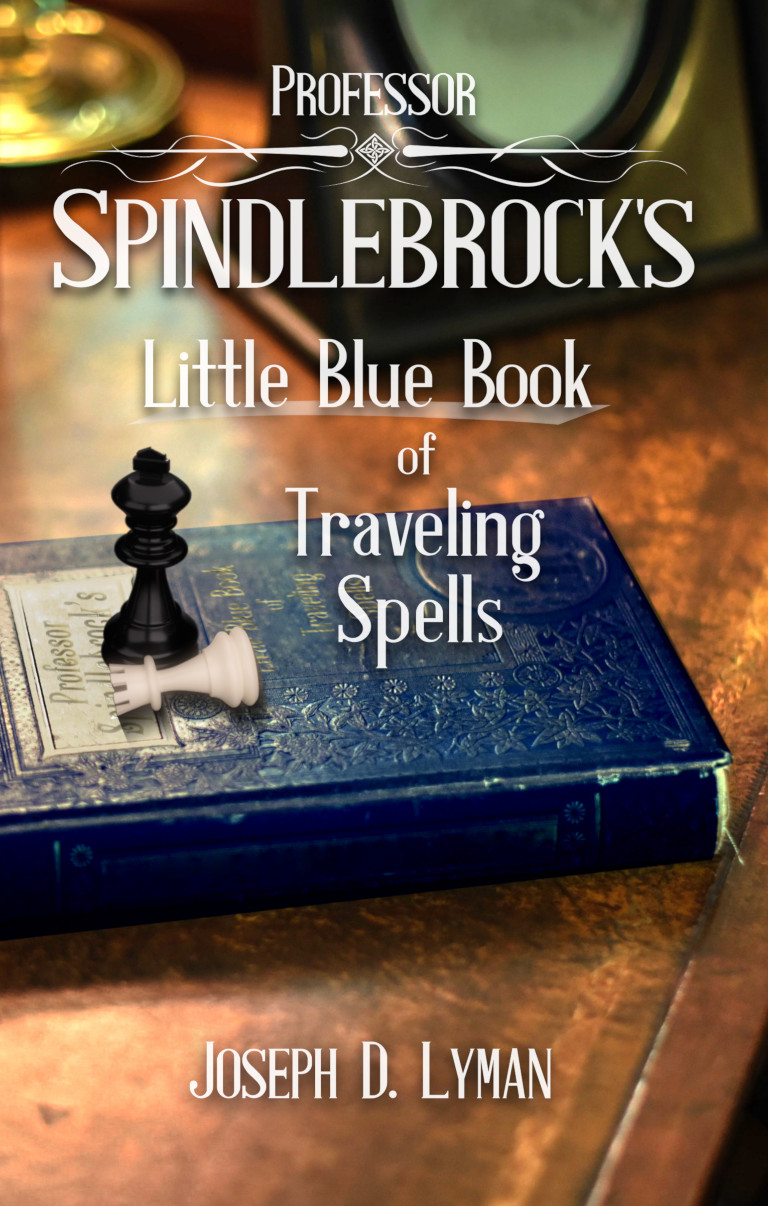
Details From Professor Spindlebrock's Little Blue Book of Traveling Spells
Dear Reader,
I'm pleased to share a little more about the first book in the Professor Spindlebrock series, Professor Spindlebrock's Little Blue Book of Traveling Spells. My original intention with this book was to create a magical mystery that did more than simply solve murders or overcome generic world-endangering super villains. I thought that folks with a college reading level might appreciate some cozy stories that touched on a world like theirs, enlarged with a parallel magical society and a global setting.
The book starts off in Ohio. For some reason, I think of middle America as the birthplace of adventure. The costal states call the middle parts the "flyover states". Having lived in such a state for most of the last decade, I can tell you a little secret: people in such states thoroughly encourage and propagate such thinking, in a vain attempt to keep the coastal folks from overrunning them. Thomas Martin, of course, didn't worry about such things.
His youth was difficult, and as a young adult Thomas found himself alone in the world. His parents had passed away suddenly, and he had lost his sister as well. The details of her death came directly from a dream that I had one night while re-writing a draft of the book. I have a fairly visual memory, and I can still see her struggling in the water (whether the memory is from the dream, or from waking up and immediately thinking of the book, I can't recall). Not everything comes from dreams, but here and there it happens.
Partially as a coping mechanism, Thomas pursued his studies in the forensic sciences with ardor. In spite of his effort he was rebuffed. As is often the case in life, his adversity was the fuel for his progress--even if it did lead him down difficult roads at first. To be more blunt, Thomas was on the road to becoming an alcoholic for a short stint. I included this portion of his life in the book, but without much detail, quite on purpose. As a character, Thomas tends to be endlessly optimistic. Some might say he is naive. And so, as he was writing in the first person, I figured that is exactly how he would approach it.
That said, I feel it was important to include, because it shows something: everyone struggles, even the optimistic naive people (I place myself in that category). No matter how much you might feel life is good, sometimes you find yourself in dark places. I felt it was important to show this up front, since most of Thomas' experiences are good (as he views and portrays them).
As he is coming out of that brush with alcoholism, Thomas finds the book. It is a chance encounter in a random book store (though the book store imagined is a real book store. I can't recall now if it was Rogers Book Barn, or another similar shop). But was it really chance? Spindlebrock doesn't see it that way, and neither do I. For that one book to show up in that one place, and for Thomas to find it. The professor calls it providence, and I tend to agree. Things happen for a reason, whether we understand it or not.
With the book, Thomas is able to locate the professor, with some effort. The location of his publishers is a real one, which you can see for yourself (either virtually or in-person). However, in reality it is just a row of shops, without a publisher (that I know of). I tried very hard to make all of my locations real and actual, even if I did put my own spin on them.
Thomas' gift, as he discovers it originally, isn't revisited in the first or second book (though it is in the third). By that I mean, the ability to use an object to find locations where a person has been, or locations that are connected to a person in a strong way. This is very clear the first time he clumsily uses his gift. Once Spindlebrock helps him hone his gift, however, this more rustic usage becomes somewhat irrelevant to him--until book three, where it becomes valuable. My son Sam suggested that I revisit this idea, and I loved the thought.
The first two people Thomas meets are the professor and Delphine. While it may not seem like it in book one, Delphine is (and always was) a main character. She is Spindlebrock's good friend, perhaps his best friend (though he may not realize it until later). They compliment one another well--which is to say, her strengths make up for his weaknesses and vice versa. Her role may be limited in these stories, but her part in Spindlebrock's story is not. You can see this reality in the way Spindlebrock responds to troubles she faces, and concerns that are connected to her.
Things get serious fairly quickly with Talbot. When I was thinking of this story, I specifically wanted a mystery that wasn't about murder. Though I'm as much a Poirot or Marple fan as anyone else, I find that murder mysteries get old quickly, and tend to overly sensationalize the evil that exists in people. And yet, when I got to the moment where Spindlebrock and Thomas discover Talbot, I knew that he would be lost. His death wasn't a great mystery, however, and the book remains a book about magical abductions and a new magical world.
Lewis comes into the story around the same time as Talbot is found (just before, as he helps in the locating). I had absolutely no intention of integrating a magical-techno-geek into this story, and therefore Lewis was just an accident. I suppose he makes sense, as I am something of a techno-geek myself, and the technology side of things comes to my mind naturally. Lewis is good for me because he provides an outlet for my technical thoughts and ideas. He also addresses the realities of the mainstream society, and the fact that magicians wouldn't simply ignore them or eschew their progress; they are a parallel society, not an isolated one. As a useful side character, Lewis comes into play in all the books.
About this time, Crane comes on the scene. I can't write much about him here, as this little letter is meant to delve into the first book, not the second and third. Crane is in all three. His character arc is loosely based on an arc found in a semi-popular old sci-fi novel that I won't name here; however, I will be quick to add that his arc is actually one that I find very realistic. For all of the first book, Crane remains a mystery.
After they get back (and some months pass), Thomas manages to work his way further into the confidence of Spindlebrock and Delphine. At one point, he finds himself having breakfast with Delphine, and he reveals the tragic events surrounding his sister's death. I have no idea how this chapter impacts the reader, but it moved me to write it. Maybe it was the dream memory, but I could imagine his feelings quite well on the matter. These events are seminal for Thomas, and they impact his decision making throughout the series, especially as it relates to people who need his help. I think we sometimes have broken processes inside our psyche; with Thomas, his sister's death broke him, in a way. He is quick to jump to the rescue of people, especially those who make him think of his sister. He does it without thinking, and if you didn't know where he was coming from, you might think he was a "sucker for a damsel in distress", as one chapter suggests. But he is not. He's just a guy who wishes that his past could be different, and doesn't want to heap more pain of regret onto his pile.
Thomas makes his own wand. A magician might practice wandless magic, or use a staff or other implement--but a wand is still one of the oldest, most studied, and most reliable of tools. As a wand is a relic of sorts, imbued with magic itself, I thought it fitting that the most effective wands would be ones that a person has fashioned themselves. This concept comes out a little in the second book as well. And if you're paying close attention, you'll note that Spindlebrock drops a tiny hint about himself in the way he talks about his interactions with the Mistlethorpe family...
Much of the rest of the story takes place in Belarus, Pau, and Turkey (though Thomas only visits one). I lived in Pau for a short time, and had some thoughts about places in the city that might be interesting to write in, but it isn't really much of a focus. Adana has some fascinating features and history, and it suited the story well. The hotel is easy to identify as the Sheraton Grand Adana. From there you can sort of find your way to general areas in the book. I spent a fair amount of time driving around on Google Maps, and recommend you do the same if you want a feel for the city.
Evalyn is introduced at Bardo's; first in the lobby for a brief moment, and then in the restaurant. My wife is the archetype of all red-haired women in my stories, and Evalyn borrows one of her names. My hope is that the reader will gather, based on the events in Bardo's restaurant and her escape at the end, that there is more to Evalyn than may first appear. She is a main character, and plays significant roles in the second and third books.
The gravel-luggage from the first book does come into play in the second book. It seems like an odd thing, but it's a little part of Spindlebrock's history. The ruins that Spindlebrock and Thomas visit are an interesting thing, which I'll leave to the reader to understand for now. A major theme of the second book ties in to that experience at the ruins of the old hotel.
It is, of course, frustrating to reach the end of a book in a series, knowing that you'll have to wait to have some things resolved. The abductions are fully resolved in the first book--at least, the mystery of them. But Crane remains uncaptured, unrevealed, and unresolved. A few mysteries are opened up that aren't explained. Book two covers a lot of ground in both those areas, and book three finishes the job.
Since this letter to you, dear reader, is entirely online, I'll consider it my prerogative to come and add to it whenever I please. I'm thrilled that you're here to explore; please, ask questions! I'll be more than happy to answer anything about the book that you might want to know.
Sincerely,
Joey Lyman Author
Get This Book